
On the quiet afternoon of 27 March 1977, the island of Tenerife woke up to a day that looked ordinary. The cool breeze of the Canary Islands, the distant roar of the Atlantic Ocean, and the slow-moving clouds wrapped around Los Rodeos Airport like any other day.
But no one knew that this day would soon be remembered for the deadliest plane crash in history — the tragedy that the world now calls the Tenerife Airport Disaster.
Two giants of the sky — KLM Flight 4805 and Pan Am Flight 1736 — would meet each other on a runway where they were never meant to be at the same time.
This is the Tenerife airport disaster full story, told in a way that feels real, human, and unforgettable.
How the Day Began: A Bomb, a Diversion, and a New Journey
Far away, at Gran Canaria Airport, a terrorist bomb exploded inside the terminal. The airport authorities immediately shut everything down. Incoming aircraft scrambled for another landing spot.
The nearest option:
Los Rodeos Airport in Tenerife.
Normally, Los Rodeos handled a small number of flights. But on this day, dozens of diverted aircraft, including two Boeing 747s — the world’s largest passenger planes — were forced to land there.
These two aircraft were:
-
KLM Flight 4805 from Amsterdam
-
Pan Am Flight 1736 from Los Angeles/New York
Passengers were irritated, hungry, confused… yet relieved to be safe on the ground.
What no one realized was that this diversion was the first step toward the Tenerife aviation accident.
Fog Arrives Like a Silent Villain
Los Rodeos Airport is known for one thing that pilots dislike the most: fog.
Thick, sudden, unpredictable fog that can drop visibility in seconds.
By the time passengers were stretching their legs and crew members were preparing for the next flight, a blanket of white started sliding across the airport.
Within minutes:
-
taxiway signs became invisible
-
aircraft silhouettes disappeared
-
the runway looked like an empty white carpet
This was the beginning of the Tenerife airport fog crash scenario — a key reason behind the tragedy.
Crowded Taxiways and the Struggle to Leave
Because so many planes were diverted, the airport was overflowing.
Aircraft were parked:
-
on the taxiway
-
on the apron
-
dangerously close to the runway
There was no space.
So when it was time to leave, ATC (air traffic control Tenerife) had no choice but to make both KLM and Pan Am taxi down the same runway — one behind the other.
The KLM aircraft moved ahead and stopped to refuel.
The Pan Am aircraft followed behind, waiting.
The fog thickened further.
The clock kept ticking.
The Tenerife Disaster Timeline: How Seconds Changed Everything
Here is how the timeline unfolded in simple, human language:
• 5:00 PM (approx.) — KLM begins preparing for departure
Passengers board again. The captain is eager to leave. He wants to reach Gran Canaria before duty hours run out.
• Pan Am is still behind KLM
They are waiting for taxi instructions.
• Taxiway confusion begins
ATC tells Pan Am to exit the runway at “Taxiway 3”.
But in the fog, the crew cannot see the sign.
• Radio messages overlap
KLM asks for clearance.
ATC begins giving instructions.
Pan Am radios at the same moment.
Signals overlap. Words get lost.
This moment becomes one of the biggest airport communication failure events in aviation history.
• The KLM captain believes he is cleared for takeoff
But in reality, ATC has only said:
“Stand by… I will call you.”
• The Pan Am plane is still on the runway
They haven’t found their exit yet.
• Fog hides everything
No pilot can see more than a few hundred meters.
• KLM begins accelerating…
The engines roar.
The giant 747 picks up speed.
It charges into the fog — unaware of what lies ahead.
• Pan Am sees lights through the fog
Too late.
“THERE HE IS! LOOK AT HIM! GODDAMN!” the Pan Am crew shouts.
• The collision
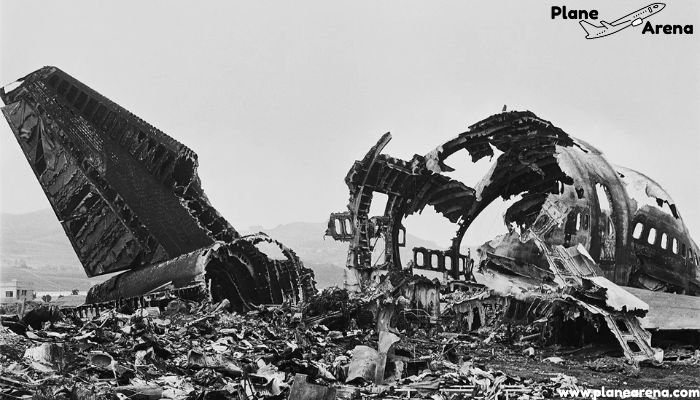
In a split second, KLM Flight 4805 slams into Pan Am Flight 1736 on the runway.
The sky turns orange.
Metal tears apart.
The world changes forever.
This is the exact moment of the runway collision Tenerife — one of the most heartbreaking moments in aviation history.
How the KLM and Pan Am Planes Collided
Many readers ask: “How did the KLM and Pan Am planes collide?”
Here is the simplest explanation:
-
KLM accelerated for takeoff — without full clearance.
-
Pan Am was still on the runway — unable to exit due to fog.
-
Visibility was nearly zero — no one could see the other airplane.
-
ATC had no ground radar — they could not see positions either.
-
Radio messages overlapped — leading to confusion.
Together, these created the KLM and Pan Am crash, forming the core of the Tenerife crash detailed analysis.
Inside the Investigation: What Experts Found
The official Tenerife crash investigation was handled by:
-
Spanish investigators
-
The U.S. National Transportation Safety Board (NTSB)
-
The Dutch authorities
They studied:
-
debris patterns
-
radio recordings
-
crew behavior
-
runway layout
-
fog conditions
-
the cockpit voice recorder Tenerife data
Key Findings (100% factual)
KLM took off without confirmed clearance
This was the main factor.
Pan Am did not exit the runway in time
But this was influenced by fog and unclear signage.
ATC instructions were misunderstood
Some words were partially blocked by overlapping radio transmissions.
Fog created a zero-visibility environment
No one could see the other aircraft.
No ground radar
ATC could not track aircraft movements.
These findings collectively explain the causes of Tenerife crash.
What the CVR (Cockpit Voice Recorder) Revealed
The CVR from both flights provided chilling but important lessons:
-
KLM’s captain was under schedule pressure
-
The first officer sounded unsure about the clearance
-
Pan Am’s crew desperately tried to find the exit
-
Overlapping radio messages created fatal confusion
-
The final seconds were filled with warnings and shouts
These recordings helped reconstruct the Tenerife airport disaster full story for training and awareness.
Lessons Learned From the Tenerife Crash
The lessons learned from Tenerife crash became part of aviation history.
1. New global radio phraseology
The word “takeoff” is now only used when ATC gives takeoff clearance.
2. Mandatory Crew Resource Management (CRM)
Co-pilots must challenge captains if they sense danger.
3. Ground radar systems installed worldwide
Airports cannot rely only on visual confirmation anymore.
4. Better taxiway signs and lighting
To prevent confusion like Pan Am faced.
These changes became standard because of this one tragedy — making the Tenerife disaster the most studied aviation disaster case study ever.
Could the Tenerife Disaster Have Been Avoided?
Experts agree: yes, it could have been avoided — if even one of the following had been different:
-
no bomb diversion
-
no sudden fog
-
clearer communication
-
ground radar
-
Pan Am finding the exit
-
KLM waiting a few more seconds
This is why the Tenerife case is cited often when discussing fog and miscommunication in Tenerife crash scenarios.
A Story That Changed Aviation Forever
The Tenerife Airport Disaster (1977) is not just the deadliest plane crash in history — it is a story of human decisions, weather, and communication failures converging at the wrong moment.
The tragedy involving KLM Flight 4805 and Pan Am Flight 1736 taught aviation experts around the world lessons that continue to save lives today.
By understanding this event through a clear, emotional, human-centered narrative, we honor the past and help ensure that such a disaster never happens again.